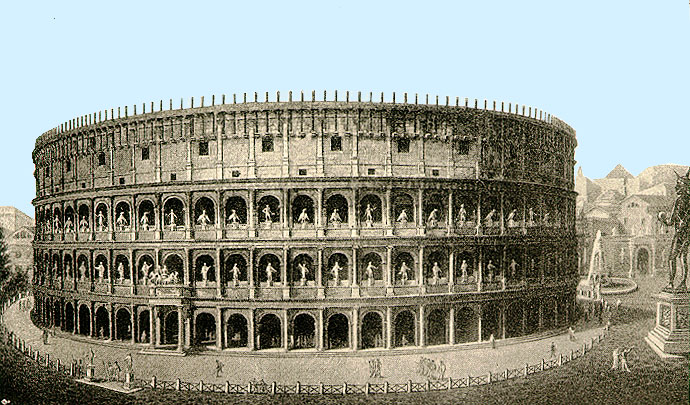
Roman Gladiators: Gladiator fights first started off in 264 BC, when 3 pairs of gladiators were fought for Brutus. Then after that, they were used as funeral rites, and evolved to the gladiatorial games we know today. It became so popular that gladiator games had their own special arena called an amphitheater ("Gladiators"). Many gladiators in Rome were slaves, or not free individuals like criminals and prisoners of war. The people who were gladiators that were free were often of very low status, and did it for money or excitement. Every gladiator had to repeat this phrase:“I will endure to be burned, to be bound, to be beaten, and to be killed by the sword” This was a sort of honor for the gladiators. Also, it was possible to rise up the ranks and become a free man and win a lot of money (Hronis 32-34).
 |
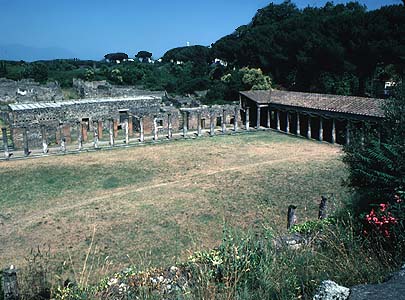
Training: The manager of a group or gladiators was called a ianista. He gave everyone all sorts of training, even learning the language because of prisoners were not part of Latin speaking areas. Even though gladiators were pitted to fight against each other, the ianista did not want them to die, so they were trained rigorously, and they were trained at the ludi, which had a exercise square and an armory (Witherbee 1).
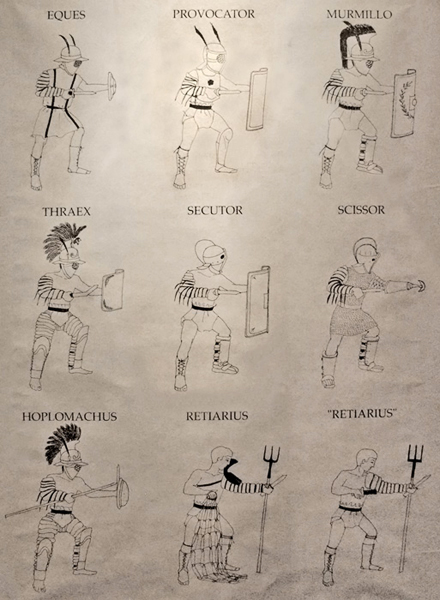
There were also different types of gladiators in the arena. (Zograf).
The Eques: Also known as the horseman, the Eques often fought with a long sword, round shield, padded shin protectors, and bronze helmets, They were the only gladiators that did not have any chest plates, as they only used their tunics.
The Hoplomachus: Named after a Greek warrior, these types of gladiators fought with a long spear, short sword, daggers. Their defensive equipment were helmets, long greaves, and a small, round shield.
Murmillo: Named after a Greek fish, these types of gladiators fought with a short stabbing sword(gladius). Their defensive equipment were helmets, rectangular, large shields, and short shin guards(ocrea).
Provocator: These types of gladiators was the most armed type of gladiator out of all the other ones. They were the only type of gladiator that wore a something that covered the upper chest area. Their defensive equipment were padded arm protectors, single greaves on the left leg, large, rectangular shields, and helmets. They fought with a stabbing sword, and generally were slower than the average gladiator due t the armor they wore.
Retarius: The Retarius were the fastest out of all the gladiators, the opposite of Provocator. They were the only type of gladiator that wore no helmet, and since the only type of protection they had were padded arm protectors(manica) with a shoulder protector(galerus), they were very vulnerable to wounds. They fought with large nets, long tridents, and small daggers.
Secutor: They were usually pitted against a Retarius, and their defensive equipment were helmets, short shin protectors(ocrea), arm protectors, and a rectangular shield. They fought with a stabbing sword.
Thraex: Named after an enemy of Rome, the Thraex fought with a short sword (sica). Their defensive equipment consists of helmets, short, rectangular shields, arm protectors, and long shin protectors(ocreae).
Bestiarius: This type of gladiator was a very special type of gladiator. They were of the lowest ranking and never became popular, and they were pitted against many different types of animals
In the morning of the gladiatorial games, the editor, or the sponsor would host a parade of a sorts. After that, a mock fight would be the first even, followed by animal displays, tricks, and animals being pitted against each other. Bestarius gladiators would also participate at this point in time to be pitted against animals (Zograf).
Lunch was for executions of condemned prisoners with serious crimes, like murder, arson, and sacrilege. They used to discourage people. One method of execution was damnatio ad bestias. Criminals could also be forced to fight in gladiator fights, and they always died because of no experience. Even if they did win, they were pitted against other gladiators until they died (Zograf).
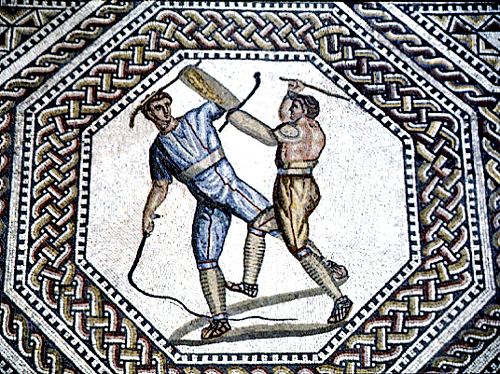
Afternoon was where the highest peak of excitement was reached. It was when individual gladiators of different types of armor and styles came to face each other, and the games were watched by a referee carrying a long stick(summa rudis). There were many rituals done in the arena, like how when a gladiator surrenders, he will hold up his index finger and the crowd would either go thumbs down which is kill and thumbs up which means to spare him. In the end, it is up to the sponsor to decide whether the gladiator dies. If he does die, he also dies in a ritual like fashion, as he is not supposed to die without flinching or crying (Zograf).
I did my project on if gladiatorial games existed in a futuristic alternate universe news report. My project can be found here
Works cited
"Gladiators." Columbia Electronic Encyclopedia, 6Th Edition (2013): 1. Literary Reference Center. Web. 21 Dec. 2014.
Hronis, Anastasia. "Ancient Roman Gladiators: Legends Of The Arena Anastasia Hronis Chronicles The Rise And Fall Of History's Greatest Warriors." History Magazine 11.4 (2010): 32-34. History Reference Center. Web. 21 Dec. 2014.
"Roman Gladiator Types." Roman Gladiator Types. N.p., n.d. Web. 07 Jan. 2015.
"The Roman Gladiator." The Roman Gladiator. N.p., n.d. Web. 07 Jan. 2015.
Works cited
"Gladiators." Columbia Electronic Encyclopedia, 6Th Edition (2013): 1. Literary Reference Center. Web. 21 Dec. 2014.
Hronis, Anastasia. "Ancient Roman Gladiators: Legends Of The Arena Anastasia Hronis Chronicles The Rise And Fall Of History's Greatest Warriors." History Magazine 11.4 (2010): 32-34. History Reference Center. Web. 21 Dec. 2014.
"Roman Gladiator Types." Roman Gladiator Types. N.p., n.d. Web. 07 Jan. 2015.
"The Roman Gladiator." The Roman Gladiator. N.p., n.d. Web. 07 Jan. 2015.
Witherbee, Amy. "Life As A Gladiator In Ancient Rome." Ancient Rome: Life As A Gladiator In Ancient Rome (2011): 1. History Reference Center. Web. 21 Dec. 2014.
Zograf, Bohdan. "Gladiatorial Games." Gladiatorial Games. N.p., n.d. Web. 21 Dec. 2014.
Images used:
http://www.vroma.org/images/mcmanus_images/colosseumdrawing.jpg
http://www.vroma.org/images/mcmanus_images/paula_chabot/arena/pcarena.03.jpg
http://www.vroma.org/images/mcmanus_images/nenning7.jpg
http://www.vroma.org/images/mcmanus_images/gladtypes_drawing.jpg
Zograf, Bohdan. "Gladiatorial Games." Gladiatorial Games. N.p., n.d. Web. 21 Dec. 2014.
Images used:
http://www.vroma.org/images/mcmanus_images/colosseumdrawing.jpg
http://www.vroma.org/images/mcmanus_images/paula_chabot/arena/pcarena.03.jpg
http://www.vroma.org/images/mcmanus_images/nenning7.jpg
http://www.vroma.org/images/mcmanus_images/gladtypes_drawing.jpg

If you had to be a gladiator, which kind would you train as, and why? Personally, I would go for the murmillo for the heavy armor.
ReplyDeleteDid the gladiators fight in extreme heat or snow? Would you be a gladiator if you could choose?
ReplyDeleteI saw the movie Pompeii... and after reading this it turns out the whole Roman Gladiators-business definitely has more to it (which is expected, Pompeii was only a movie). But anyways nice job, your pictures and quote integrate well into your research as well.
ReplyDeleteWhat was the fatality rate of gladiators? Personally I would not like to involve myself in such dangerous sports.
ReplyDelete